|
The Royal Library of Alexandria in Alexandria, Egypt, was once the largest library in the world. It is generally thought to have been founded at the beginning of the 3rd century BC, during the reign of Ptolemy II of Egypt. It was likely created after his father had built what would become the first part of the Library complex, the temple of the Muses — the Museion, Greek Μουσείον (from which the modern English word museum is derived).
It has been reasonably established that the Library, or parts of the collection, were destroyed by fire on a number of occasions (library fires were common and replacement of handwritten manuscripts was very difficult, expensive and time-consuming). To this day the details of the destruction (or destructions) remain a lively source of controversy. The Bibliotheca Alexandrina was inaugurated in 2003 near the site of the old Library.
Bibliotheca Alexandrina
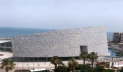
The Bibliotheca Alexandrina is a major library and cultural center located on the shore of the Mediterranean Sea in the Egyptian city of Alexandria. It is both a commemoration of the Library of Alexandria that was lost in antiquity and an attempt to rekindle something of the brilliance that this earlier center of study and erudition represented.
The idea of reviving the old library dates back to 1974, when a committee set up by the Alexandria University selected a plot of land for its new library, between the campus and the seafront, close to where the ancient library once stood. The notion of recreating the ancient library was soon enthusiastically adopted by other individuals and agencies. One leading supporter of the project was current Egyptian President Hosni Mubarak; UNESCO was also quick to embrace the idea of endowing the Mediterranean region with a center of cultural and scientific excellence. An architectural competition, organized by UNESCO in 1988 to choose a design worthy of the site and its heritage, was won by Snhetta, a Norwegian architectural office, from among more than 1,400 entries. At a conference held in 1990 in Aswan, the first pledges of funding for the project were made: USD $65 million, mostly from the Arab states. Construction work began in 1995 and, after some USD $220 million had been spent, the complex was officially inaugurated on October 16, 2002.
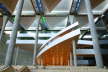
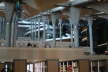
The dimensions of the project are vast: the library has shelf space for eight million books, with the main reading room covering 70,000 m² on eleven cascading levels. The complex also houses a conference center; specialized libraries for the blind, for young people, and for children; three museums; four art galleries; a planetarium; and a manuscript restoration laboratory.
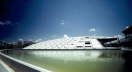
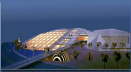
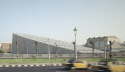
The library's architecture is equally striking. The main reading room stands beneath a 32-meter-high glass-panelled roof, tilted out toward the sea like a sundial, and measuring some 160 m in diameter. The walls are of gray Aswan granite, carved with characters from 120 different human scripts.
Collections
The collections at the Bibliotheca Alexandrina were donated from all over the world. The Spanish donated documents that detailed the ruling of the Moors. The French also donated, giving the library documents dealing with the building of the Suez Canal. For the most part, the library has closed stacks, since many of the artifacts are so rare. Instead, there is a reading room, on the 10th floor, which can hold 2,500 people. There, scholars will be able to look at these items from the world's past. There are even special closed off rooms that deal with the most precious of artifacts.
Bibliotheca Alexandrina also maintains a copy of the Internet Archive.
Overview
The New Library of Alexandria, the New Bibliotheca Alexandrina is dedicated to recapture the spirit of openness and scholarship of the original Bibliotheca Alexandrina. It is much more than a library. It contains:
- A Library that can hold millions of books.
- An Internet Archive
- Six specialized libraries for
- Arts, multimedia and audio-visual materials,
- the visually impaired,
- children,
- the young,
- microforms, and
- rare books and special collections
- Four Museums for
- Antiquities,
- Manuscripts,
- Sadat and
- the History of Science
- A Planetarium
- An Exploratorium for children’s exposure to science (ALEXploratorium)
- Culturama: a cultural panorama over nine screens, the first ever patented 9-projector interactive system. Winner of many awards, the Culturama, developed by CULTNAT, allows the presentation of a wealth of data layers, where the presenter can click on an item and go to a new level of detail. It is a remarkably informative and attractive multi-media presentation of Egypt’s heritage across 5000 years of history to these modern times, with highlights and examples of Ancient Egyptian and Coptic/Muslim heritage.
- VISTA (The Virtual Immersive Science and Technology Applications system) is an interactive Virtual Reality environment, allowing researchers to transform two-dimensional data sets into 3-D simulations, and to step inside them. A practical tool of visualization during research, VISTA helps researchers to simulate the behavior of natural or human-engineered systems, instead of merely observing a system or building a physical model.
- Eight academic research centers:
- Alexandria and Mediterranean Research Center (Alex-Med),
- Arts Center,
- Calligraphy Center,
- Center for Special Studies and Programs (CSSP),
- International School of Information Studies (ISIS),
- Manuscript Center,
- Center for the Documentation of Cultural and Natural Heritage (CultNat, located in Cairo), and
- Alexandria Center for Hellenistic Studies.
- Fifteen permanent exhibitions covering
- Impressions of Alexandria: The Awad Collection,
- The World of Shadi Abdel Salam,
- Arabic Calligraphy,
- The History of Printing,
- Arab-Muslim Medieval Instruments of Astronomy and Science (Star Riders), and the Permanent Exhibitions of Selections of Contemporary Egyptian Art:
- The Artists Book,
- Mohie El Din Hussein: A Creative Journey,
- Abdel Salam Eid,
- The Raaya El-Nimr and Abdel-Ghani Abou El-Enein Collection Arab Folk Art,
- Seif and Adham Wanly: Motion and Art,
- Selected Artworks of Adam Henin,
- Selected Artworks of Ahmed Abdel-Wahab,
- Selected Artworks of Hamed Saeed,
- Selected Artworks of Hassan Soliman, and
- Sculpture.
- Four art galleries for temporary exhibitions
- A Conference Center for thousands of persons
- A Dialogue Forum which provides opportunities for the meeting of thinkers, authors and writers to discuss various salient issues affecting modern societies. The Arab Reform Forum was the product of the first Arab Reform Conference organized in 2004.
The number is growing and the Library of Alexandria is becoming the nerve center of many international and regional networks.
- The Academia Bibliotheca Alexandrinae (ABA)
- Arabic Society for Ethics in Science & Technology (ASEST)
- The Anna Lindh Foundation for Dialogue between Cultures, the first Euro–Med foundation based outside Europe
- The Center for Peace and Democracy Studies (CPDS)
- The HCM Medical Research project (located in Shallalat premises)
- The Jean-René Dupuy Center for Law and Development
- The Arab Regional Office of the Academy of Science for the Developing World (ARO-TWAS)
- The International Federation for Library Associations (IFLA) Regional Office
- The Secretariat of the Arab National Commissions of UNESCO
- The Middle Eastern and North African Network for Environmental Economics (MENANEE)
- The Arab Network for Women in Science and Technology (ANWST)
The New Library of Alexandria also hosts a number of institutions:
Today, this vast complex is a reality
receiving about 1.5 million visitors a year
|